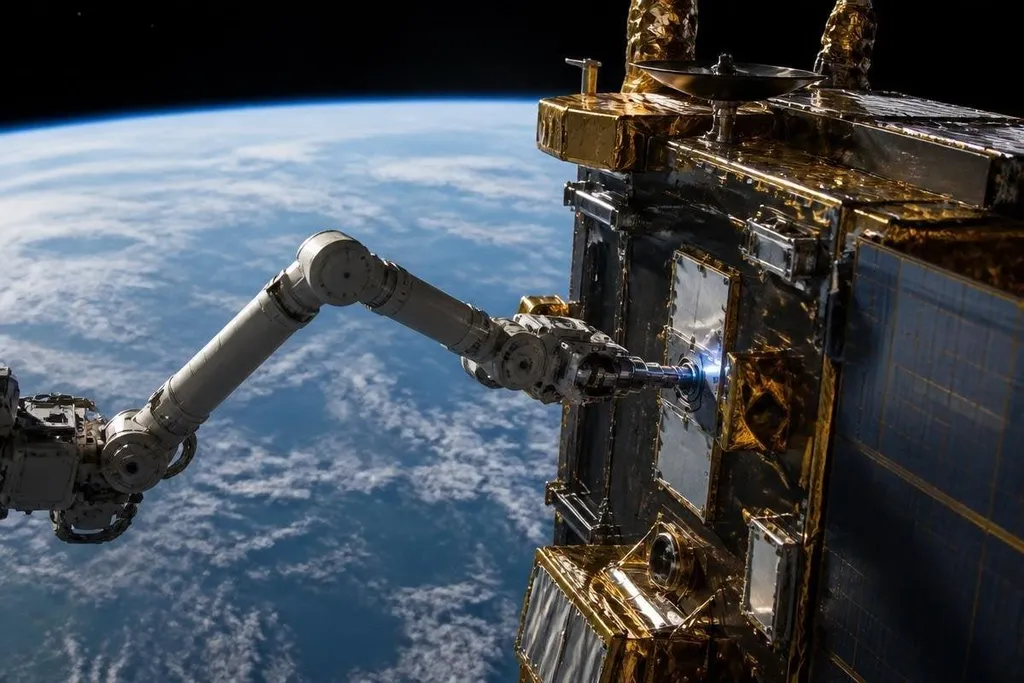
A satellite repair robot would need to do more than reach a spacecraft. It would need to find a safe handhold, understand the damaged hardware, and apply force without sending the satellite spinning. That makes inspection the first job, with repair coming only after the robot knows what it can touch.
- Inspection comes first: Cameras, depth sensors, and force sensors could help map damage before contact.
- Standard parts would help: Handles, fasteners, and connectors designed for robot access would reduce risk.
- Human control may remain: Operators could guide difficult work while the robot handles steady motions.
Finding a safe place to work
During an approach, the robot would first need to match the satellite’s motion. The spacecraft may be moving and rotating, so the robot must estimate its position, speed, and spin before it reaches an arm or panel.
Cameras could identify known shapes, while LiDAR measures distance with laser pulses. The robot could compare those readings with a stored model of the satellite, then plan a slow path to a chosen contact point. That path would need room for the robot’s arm, tools, cables, and solar panels.
Contact changes the problem. Pushing against a free-flying satellite can move the satellite instead of turning a bolt. A grappling arm or docking tool could hold the robot in place, letting its other arm work without passing that force into the spacecraft.
Inspecting damage before repair
A camera can find a torn surface or a loose cover. It may not tell the robot whether a connector is bent, a panel is hot, or a fastener still holds its load. Force sensors in the arm and tool would add that missing information.
The robot could touch a part with a low force, measure how it moves, and compare the result with the expected response.
A panel that shifts too far may have a broken mount. A connector that refuses to seat may have damage inside its housing. These checks would help the operator choose a repair path before the tool applies more force.
This is where repair plans need clear limits. In some cases, the robot might replace an exposed panel, move a cable, or turn a fastener that was designed for access. It may struggle with torn metal, parts hidden behind other hardware, or damage that has changed the shape of the satellite.
Tools, control, and the human role
The arm would need tool changes for different jobs. A gripper could hold a cover, a driver could turn a fastener, and a cutter could remove a damaged cable. Each tool adds mass and another point where a command can fail.
Operators on Earth could guide the robot through unfamiliar work. The robot could hold its position, limit arm speed, and stop when force readings cross a set limit. That division gives people control over judgment while the robot repeats slow movements without tiring.
Mission plans and hardware tests carry more weight than a smooth animation. Robot24.com can link a satellite-servicing claim to the robot, task, and test details behind it before you judge what the arm can repair.
Autonomous control would still have a place. A robot could keep a camera aimed at a work area, hold a tool against a surface, or return to a safe position after a sensor warning. It should not decide on its own to cut a cable or remove a part when the result cannot be reversed.
Designing satellites for robotic repair
Many repair problems begin before launch. A satellite built for service could include handholds, visual markers, tool sockets, standard connectors, and panels that open without a person’s hand. Those features would give a repair robot known places to grip and known motions to follow.
The design would also need to account for heat, radiation, vacuum, glare, and limited room around the spacecraft. A connector that works well on a clean factory floor may be hard to see and harder to push into place after years in orbit.
The strongest case may be planned servicing rather than rescue. A service robot working with a satellite made for robotic access has a known shape, known tools, and approved contact points. An old satellite with no such features could cost more to approach than its remaining work is worth.
A decision guide for mission planners
Before choosing a repair robot, check these points:
- Define the task: State the exact part to inspect, remove, replace, or reconnect.
- Map contact points: Confirm where the robot can grip without loading fragile hardware.
- Set force limits: Give the arm a stop point for each contact and tool motion.
- Plan tool changes: Check how the robot carries, releases, and locks each tool.
- Keep a human in control: Assign an operator to approve actions that can cause permanent damage.
- Design for return: Give the robot a clear safe position if power, control, or sensor data fails.
I’d treat robotic satellite repair as a hardware design problem before treating it as an autonomy problem. The next useful proof will be a robot inspecting and fixing a service-ready spacecraft mock-up while its operators publish the force limits, tool steps, and failed attempts.